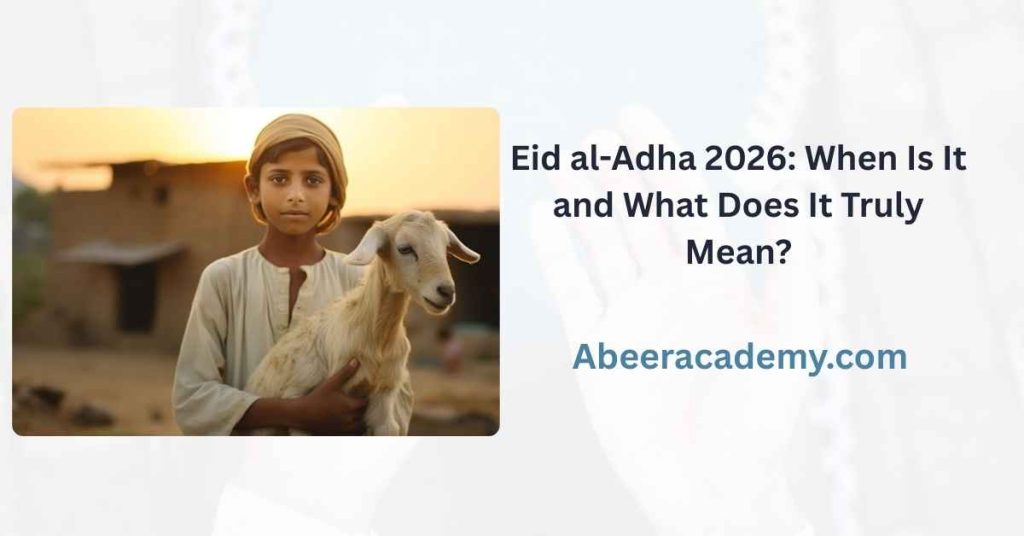
Eid al-Adha 2026 — When Is It and What Does It Truly Mean?
Eid al-Adha 2026 is expected to begin on the evening of Tuesday, 26 May 2026, with the day of Eid most likely falling on Wednesday, 27 May 2026, and the days of celebration continuing until Saturday, 30 May 2026. These dates remain subject to the sighting of the moon of Dhul Hijjah, and therefore may vary slightly from country to country. This blessed festival occurs on the tenth day of Dhul Hijjah, the final and most sacred month of the Islamic lunar calendar, coinciding with the culmination of Hajj, when millions of pilgrims gather in Makkah to perform the sacred rites that honour the legacy of Prophet Ibrahim عليه السلام.
For over two decades of teaching Qur’an, Hadith, and Fiqh, I have observed that many Muslims know when Eid al-Adha occurs, but far fewer understand why it carries such immense weight in the Islamic tradition. Eid al-Adha is not merely a celebration; it is a living remembrance of a test of faith that has no equal in human history.

The Qur’anic Foundation of the Sacrifice
The story of Eid al-Adha is rooted directly in the Qur’an, in the moving account of Prophet Ibrahim and his son Ismail عليهما السلام:
فَلَمَّا بَلَغَ مَعَهُ السَّعْيَ قَالَ يَا بُنَيَّ إِنِّي أَرَىٰ فِي الْمَنَامِ أَنِّي أَذْبَحُكَ فَانظُرْ مَاذَا تَرَىٰ
“And when he reached with him [the age of] effort, he said, ‘O my son, indeed I have seen in a dream that I must sacrifice you, so see what you think.’” (Qur’an 37:102)
Ismail’s response remains one of the most profound statements of submission ever uttered:
قَالَ يَا أَبَتِ افْعَلْ مَا تُؤْمَرُ سَتَجِدُنِي إِن شَاءَ اللَّهُ مِنَ الصَّابِرِينَ
“He said, ‘O my father, do as you are commanded. You will find me, if Allah wills, among the patient.’” (Qur’an 37:102)
And when both submitted fully:
وَفَدَيْنَاهُ بِذِبْحٍ عَظِيمٍ
“And We ransomed him with a great sacrifice.” (Qur’an 37:107)
This is the spiritual root of Qurbani.
Why Eid al-Adha Is So Important in Islam
Eid al-Adha commemorates not the act of slaughter, but the perfection of obedience. Ibrahim did not hesitate. Ismail did not resist. Both submitted. That submission is the essence of Islam.
Allah makes this clear:
لَن يَنَالَ اللَّهَ لُحُومُهَا وَلَا دِمَاؤُهَا وَلَٰكِن يَنَالُهُ التَّقْوَىٰ مِنكُمْ
“Their meat will not reach Allah, nor will their blood, but what reaches Him is your piety.” (Qur’an 22:37)
For this reason, Eid al-Adha is a festival of Taqwa, not tradition; of obedience, not culture.
The Connection Between Eid al-Adha and Hajj
Eid al-Adha occurs while pilgrims stand on the plains of Arafat, the greatest day of the year. The Prophet ﷺ said:
الحج عرفة
“Hajj is Arafah.” (Tirmidhi)
While pilgrims relive the legacy of Ibrahim in Makkah, Muslims around the world revive that same legacy through Qurbani.
The Sunnah of Qurbani and Its Rules
The Prophet ﷺ never abandoned Qurbani after it was legislated. Anas ibn Malik رضي الله عنه reports:
“The Prophet ﷺ sacrificed two horned rams with his own hands, saying Bismillah and Allahu Akbar.” (Bukhari, Muslim)
The animals must meet specific conditions:
- Goat or sheep: one year old
- Cow or buffalo: two years old
- Camel: five years old
- Free from defects (blindness, lameness, illness)
The meat is divided into three parts: for family, relatives/friends, and the needy.
The Eid Prayer: A Public Declaration of Faith
The day begins with Salat al-Eid, a two-rak‘ah congregational prayer with extra takbirs. The Prophet ﷺ encouraged men, women, and even young girls to attend. (Bukhari)
This prayer is not optional in spirit; it is a symbol of the Ummah’s unity.
Eid al-Adha Traditions Rooted in Sunnah
Among the Sunnah practices:
- Performing ghusl
- Wearing the best clothes
- Reciting Takbir from Fajr of 9th Dhul Hijjah until Asr of 13th
- Taking one route to Eid prayer and returning by another
These acts revive prophetic tradition in daily life.
The Power of Giving on Eid al-Adha 2026
In many parts of the world, families may not taste meat except on Eid. Qurbani becomes a means of relief for widows, orphans, and refugees. The spirit of Eid is fulfilled when the sacrifice reaches the hungry before it reaches our own tables.
Continuing the Spirit of Ramadan into Dhul Hijjah
The first ten days of Dhul Hijjah are greater than any other days of the year. The Prophet ﷺ said:
“There are no days in which righteous deeds are more beloved to Allah than these ten days.” (Bukhari)
Eid al-Adha arrives at the peak of these days, reminding believers to carry forward the discipline of Ramadan.
What Is Qurbani Eid in Its True Sense?
Qurbani Eid is the day Muslims prove that love for Allah is greater than love for wealth, comfort, and attachment. The animal is only a symbol; the real sacrifice is within the heart.
Preparing for Eid al-Adha 2026
Preparation begins before Eid:
- Confirm moon sighting announcements
- Arrange Qurbani early
- Increase in dhikr, dua, and charity
- Fast on the Day of Arafah (9th Dhul Hijjah)
The Prophet ﷺ said regarding this fast:
“It expiates the sins of the previous year and the coming year.” (Muslim)
How Muslims Celebrate Eid al-Adha Around the World
From Makkah to small villages, Muslims gather, pray, sacrifice, share food, and visit relatives. Despite cultural differences, the message remains identical: submission to Allah.
Teaching the Meaning of Eid to the Next Generation
One of the greatest responsibilities I have observed in teaching is helping children understand that Eid is not about clothes and sweets, but about Ibrahim’s test. When children learn this, Eid becomes meaningful for life.
Institutions such as Tarteel E Quran Online Academy play an important role in educating families and children about the authentic meanings behind Islamic rituals, ensuring that Eid is understood through Qur’an and Sunnah rather than culture alone.
The Takbir of Eid al-Adha
From the dawn of 9th Dhul Hijjah, Muslims recite:
الله أكبر الله أكبر لا إله إلا الله، الله أكبر الله أكبر ولله الحمد
This Takbir fills homes, streets, and mosques with the remembrance of Allah.
The Social and Spiritual Wisdom Behind Meat Distribution
Islam ensures dignity for the poor. They do not beg on Eid; they receive honourably from the Ummah’s sacrifice.
The Legacy of Ibrahim Lives On Every Year
Every Eid al-Adha is a renewal of Ibrahim’s legacy. His test did not end; it continues in every believer’s life whenever obedience is required over desire.
When Is Eid al-Adha 2026 Confirmed?
While astronomically expected around 27 May 2026, the final confirmation depends on moon sighting in each region. Muslims should follow their local authorities for the official announcement.
How to Perform Eid al-Adha Prayer
Two rak‘ahs with extra takbirs, followed by the khutbah. It is recommended to listen attentively and return home with joy and gratitude.
The Inner Message of Eid al-Adha
Eid al-Adha teaches that Islam is submission, Qurbani is sincerity, and celebration is gratitude.
📘 FAQ Answers
Q1: How many days is Eid-ul-Adha 2026?
A: Eid-ul-Adha in 2026 is typically celebrated over 3 to 4 days depending on the region.
The festival begins on 10th Dhul Hijjah and extends through the following Tashreeq days, so most Muslims observe it for three main days of celebration and sacrifice.
Q2: What are the two dates for Eid 2026?
A: In 2026 there are two Eids:
-
Eid al-Fitr expected on March 20, 2026 (end of Ramadan)
-
Eid al-Adha expected on May 27, 2026 (Festival of Sacrifice).
These dates are based on moon sighting predictions.
Q3: How many days off for Eid al-Fitr 2026?
A: Governments usually grant 2–3 days off for Eid al-Fitr in 2026.
Public holidays for this festival typically include the first day of Shawwal plus one or two extra days for family celebrations and rest.
Q4: What is the date of Qurbani Eid 2026?
A: Qurbani Eid (Eid al-Adha) in 2026 is expected on May 27, 2026.
That’s the day when Muslims offer the sacrifice (Qurbani) and pray the special Eid prayer, calculated by the lunar calendar’s 10th Dhul Hijjah.
Q5: Is 2026 have two Ramadan?
A: No — there will be only one Ramadan in 2026.
The Islamic lunar year has about 12 months, and Ramadan shifts earlier each solar year, but it won’t repeat within the same Gregorian year.
Q6: Is June 6, 2025 a holiday in Pakistan?
A: Yes, June 6, 2025 was Eid al-Adha in many countries, including Pakistan, as part of the Eid festival.
This was a public holiday for Muslims celebrating Bakra Eid that year.
Q7: Why is Ramadan so early in 2026?
A: Ramadan falls earlier each year because the Islamic calendar is lunar, about 10–11 days shorter than the solar year.
So each year, Ramadan begins roughly 10 days earlier on the Gregorian calendar.
Q8: Is there a 3 Eid in 2030?
A: Yes — in 2030 there will be two separate Ramadan months according to astronomical predictions, leading to two Eids within the same Gregorian year: one after the early-year Ramadan and one at the year’s end.
However, there will still be only two Eids (Eid al-Fitr and Eid al-Adha), not three.
Q9: What date is Ramadan 2026?
A: Ramadan 2026 is expected to start around February 18–19, 2026 and end around March 19–20, 2026 depending on the moon sighting.
This month of fasting, prayer, and reflection shifts each year with the lunar calendar.
Q10: How many dates are there for Eid al-Adha 2025?
A: Eid al-Adha 2025 was observed from June 7–9, 2025 in many countries, with public holidays often spanning three days.
These dates vary slightly by region based on Islamic calendar calculations.
Q11: What will happen in 2026 according to Islam?
A: In Islam, 2026 includes important lunar events like Ramadan, Eid al-Fitr, Eid al-Adha, and later the Islamic New Year (Muharram) around June.
These occur as part of the annual Islamic calendar cycle based on moon sightings.
Q12: Is it possible to have 3 Eids in one year?
A: No, three separate Eid festivals in one calendar year is not standard.
Islam recognises two main Eids — Eid al-Fitr and Eid al-Adha — each tied to specific lunar months.
Q13: How many Eids are there in 2026?
A: There will be two Eids in 2026:
-
Eid al-Fitr after Ramadan
-
Eid al-Adha during Dhul Hijjah.
Islamic tradition fixes these two celebrations each year.
Q14: Which festival is on 14 September 2026?
A: There’s no widely observed Islamic holiday on 14 September 2026.
Any celebration on that date would stem from national culture or secular calendars, not the Islamic lunar calendar.
Q15: How long is Eid al-Adha 2026?
A: Eid al-Adha 2026 is celebrated over 3 days, though some regions observe up to 4 days including the day before (Arafah) or local public holidays.
The core festival spans Dhul Hijjah 10–12.
Q16: Can I kiss my wife in Ramzan?
A: Yes, affectionate contact between husband and wife is allowed in Islam during Ramadan.
However, avoid actions that break the fast (like sexual intercourse) in daylight hours; affectionate kissing is acceptable if it doesn’t lead to breaking the fast. (General Islamic fiqh guidance)