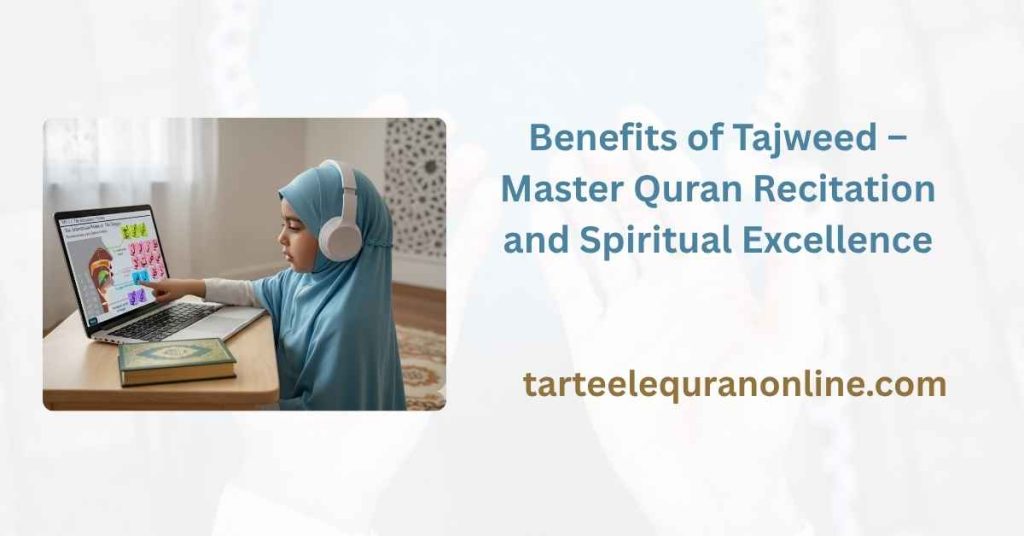
Learning the benefits of Tajweed is essential for anyone studying the Qur’an. Tajweed is the science of proper Quranic pronunciation, ensuring every letter is articulated correctly, preserving meanings, and following the Sunnah of the Prophet ﷺ. Beyond rules, Tajweed beautifies recitation, strengthens spiritual connection, aids memorization (Hifz), and increases rewards from Allah ﷻ.
Students who master Tajweed experience clearer, more accurate, and meaningful recitation, allowing the Qur’an to touch the heart deeply. With guidance from qualified teachers, including online platforms like Tarteel E Quran Online Academy, learners can practice Tajweed effectively from anywhere, building both confidence and discipline in their Quranic journey.
Benefits of Tajweed
The science of Tajweed occupies a central place in the study of the Qur’an, for it governs the manner in which the words of Allah ﷻ are recited. To speak about the benefits of Tajweed is not merely to discuss technical rules of pronunciation, but to reflect upon a sacred discipline that preserves the integrity, beauty, and spiritual depth of the Divine Revelation.
After more than twenty years of teaching Qur’an, Hadith, and Fiqh, I have come to realize that Tajweed is often misunderstood by students as a set of rigid rules. In reality, it is a means of honoring the كلام الله (Speech of Allah), ensuring that it is recited exactly as it was revealed to the Prophet Muhammad ﷺ.

The Divine Command Behind Tajweed
The foundation of Tajweed lies in the command of Allah ﷻ:
وَرَتِّلِ الْقُرْآنَ تَرْتِيلًا
“And recite the Qur’an with measured recitation.”
(Qur’an 73:4)
This verse establishes the obligation of reciting the Qur’an with care, clarity, and proper articulation. The word Tarteel implies not only correct pronunciation but also reflection and composure.
Tajweed, therefore, is not an optional refinement—it is a fulfillment of this divine command.
Preservation of the Qur’an Through Tajweed
One of the greatest benefits of Tajweedis the preservation of the Qur’an’s original form. The Qur’an has been transmitted from generation to generation through precise oral recitation.
Allah ﷻ declares:
إِنَّا نَحْنُ نَزَّلْنَا الذِّكْرَ وَإِنَّا لَهُ لَحَافِظُونَ
“Indeed, We have sent down the Reminder, and indeed, We will be its guardian.”
(Qur’an 15:9)
The preservation mentioned in this verse includes both the written text and the correct method of recitation. Tajweed ensures that every letter is pronounced from its proper articulation point (makhraj) with its correct characteristics (sifaat).
Without Tajweed, subtle changes in pronunciation could alter meanings, thereby compromising the integrity of the Qur’an.
Protecting the Meaning of the Qur’an
Arabic is a precise language in which slight variations in pronunciation can lead to significant changes in meaning. One of the essential benefits of Tajweed is safeguarding the intended meanings of Qur’anic words.
For example, mispronouncing a single letter may transform a word into something entirely different. Tajweed acts as a protective system, ensuring that each word is recited accurately.
In my years of teaching, I have encountered students who unknowingly altered meanings due to incorrect pronunciation. Once they learned Tajweed, their recitation became both accurate and meaningful.
Following the Sunnah of the Prophet ﷺ
The Prophet Muhammad ﷺ recited the Qur’an with perfect articulation and taught his companions to do the same. Learning Tajweed is therefore an act of اتباع (following the Sunnah).
The Messenger of Allah ﷺ said:
“Recite the Qur’an as you have been taught.”
(Abu Dawood, authenticated by scholars)
This hadith emphasizes that the method of recitation is not left to personal preference; rather, it must be learned from qualified teachers who preserve the Prophetic tradition.
Attaining Spiritual Excellence in Recitation
Tajweed beautifies the recitation of the Qur’an. When the rules are applied correctly, the recitation flows with rhythm, clarity, and harmony.
The Prophet ﷺ encouraged beautifying the recitation:
“Beautify the Qur’an with your voices.”
(Sahih al-Bukhari, 7527)
This beauty is not merely aesthetic; it enhances concentration and humility. A properly recited verse penetrates the heart more deeply, allowing the listener to reflect upon its meaning.
Students who learn Tajweed often experience a transformation in their recitation—from mechanical reading to a spiritually engaging act of worship.
Increased Rewards from Allah
Every letter of the Qur’an carries immense reward. The Prophet ﷺ said:
“Whoever recites a letter from the Book of Allah will receive a reward, and that reward will be multiplied tenfold.”
(Jami‘ al-Tirmidhi, 2910)
When recitation is performed with Tajweed, the act becomes more complete and aligned with the command of Allah, thereby enhancing its spiritual value.
Even those who struggle are greatly rewarded:
“The one who recites the Qur’an and struggles with it will have two rewards.”
(Sahih al-Bukhari 4937; Sahih Muslim 798)
This hadith offers encouragement to every learner, reminding them that effort itself is rewarded.
Strengthening Connection with the Qur’an
One of the most profound benefits of Tajweed is the strengthening of one’s relationship with the Qur’an. When a person recites with proper pronunciation, the experience becomes more engaging and meaningful.
Allah ﷻ says:
أَفَلَا يَتَدَبَّرُونَ الْقُرْآنَ
“Do they not reflect upon the Qur’an?”
(Qur’an 4:82)
Reflection (tadabbur) is enhanced when recitation is clear and correct. Tajweed allows the reciter to slow down, focus, and absorb the message of each verse.
In my teaching experience, students who master Tajweed often develop a deeper emotional and spiritual connection with the Qur’an.
Building Confidence in Recitation
Many students hesitate to recite the Qur’an publicly due to fear of making mistakes. Learning Tajweed builds confidence by providing clarity and precision.
A student who understands the rules of Tajweed knows how to approach each word correctly. This confidence encourages regular recitation and participation in communal عبادات (acts of worship).
Facilitating Memorization (Hifz)
Tajweed plays a crucial role in memorization of the Qur’an. Proper pronunciation and rhythm make it easier to remember verses accurately.
Students who learn Tajweed alongside memorization tend to retain their lessons more effectively. The structured patterns of Tajweed create a natural flow that aids memory.
In many Hifz programs, Tajweed is taught from the beginning to ensure that memorization is both accurate and lasting.
Tajweed as a Means of Discipline
Learning Tajweed requires patience, consistency, and attention to detail. These qualities develop discipline in students, which extends beyond Qur’an recitation into other areas of life.
Students learn to:
- Practice regularly
- Focus on precision
- Accept correction
- Strive for improvement
Such habits contribute to both academic and spiritual growth.
The Role of Qualified Teachers in Learning Tajweed
Tajweed cannot be mastered through books alone. It requires direct guidance from a qualified teacher who can listen, correct, and guide the student.
Allah ﷻ instructs:
فَاسْأَلُوا أَهْلَ الذِّكْرِ إِن كُنتُمْ لَا تَعْلَمُونَ
“So ask the people of knowledge if you do not know.”
(Qur’an 16:43)
A teacher ensures that mistakes are corrected early and that the student progresses in a structured manner.
Institutions such as Tarteel E Quran Online Academy have played an important role in making Tajweed learning accessible through qualified teachers and organized programs, enabling students to learn correctly regardless of their location.
Overcoming Challenges in Learning Tajweed
Many students initially find Tajweed difficult due to unfamiliar sounds and detailed rules. However, these challenges can be overcome with patience and consistent practice.
In my experience, the most successful students are those who:
- Practice regularly
- Recite aloud
- Seek feedback
- Remain patient
Gradually, what once seemed difficult becomes natural and effortless.
A Reflection from Years of Teaching
Over the past two decades, I have taught students from various backgrounds—children, adults, and even elderly learners. Many began their journey with hesitation, unsure of their ability to learn Tajweed.
Yet, with consistent effort and proper guidance, they achieved remarkable progress. I have seen students who once struggled with basic pronunciation eventually recite the Qur’an with clarity and confidence.
This transformation is a testament to the power of Tajweed as both a علم (science) and a spiritual discipline.
The Inner Transformation Through Tajweed
Ultimately, the benefits of Tajweed extend beyond correct pronunciation. Tajweed cultivates humility, mindfulness, and reverence for the words of Allah.
When a believer recites the Qur’an with care and precision, it reflects a القلب الحاضر (present heart)—a heart that is attentive, sincere, and connected to its Creator.
Through Tajweed, the Qur’an is not merely read; it is honored, preserved, and lived.
FAQ Answers
Q1: What is Tajweed and why is it important?
A: Tajweed is the set of rules for correct pronunciation and recitation of the Quran. It ensures each letter is pronounced properly and the Quran is read as it was revealed.
Learning Tajweed is important because it preserves the Quran’s original meaning, prevents mistakes, and shows respect for Allah’s words.
Q2: How does Tajweed improve Quran recitation?
A: Tajweed improves Quran recitation by teaching proper articulation, rhythm, and pauses. It makes reading clear, accurate, and melodious.
By following Tajweed rules, reciters can pronounce each letter correctly, avoid common errors, and maintain the flow and beauty of the Quranic verses.
Q3: Can learning Tajweed help in memorizing the Quran?
A: Yes, learning Tajweed helps in memorizing the Quran because proper pronunciation aids memory retention.
When each word and letter is recited correctly, it becomes easier to recall verses accurately, making Hifz (memorization) more effective and structured.
Q4: Does Tajweed protect against mispronouncing Quranic words?
A: Yes, Tajweed protects against mispronouncing Quranic words by teaching the correct articulation of letters and sounds.
Following Tajweed rules ensures that no letters are skipped, elongated incorrectly, or mispronounced, maintaining the Quran’s authenticity and meaning.
Q5: How does Tajweed enhance understanding of the Quran?
A: Tajweed enhances understanding by clarifying the correct pronunciation and meaning of words. Accurate recitation prevents confusion between similar-sounding letters and words.
This makes it easier to comprehend the message of the Quran and ensures that the intended meaning of each verse is preserved during reading.
Q6: Can Tajweed improve fluency and confidence in recitation?
A: Yes, Tajweed improves fluency and confidence by providing clear rules for smooth, accurate recitation.
As learners practice and master Tajweed, they gain confidence in reading aloud, recite with correct rhythm, and enjoy a more natural, flowing Quranic recitation.
Q7: Does Tajweed help in learning proper Arabic pronunciation?
A: Yes, Tajweed teaches proper Arabic pronunciation, including articulation points and letter characteristics.
It helps learners pronounce vowels, consonants, and special sounds correctly, improving both recitation and overall spoken Arabic skills.
Q8: Are there spiritual benefits to reciting Quran with Tajweed?
A: Yes, reciting the Quran with Tajweed brings spiritual rewards, tranquility, and closeness to Allah.
Beautiful and accurate recitation reflects respect for Allah’s words and enhances the experience of connecting with the Quran during prayer and reflection.
Q9: Can adults and children both benefit from learning Tajweed?
A: Yes, both adults and children can benefit from learning Tajweed. Children develop proper pronunciation early, while adults improve accuracy, fluency, and understanding.
Tajweed is suitable for all ages and strengthens Quranic recitation skills, making it easier to read, memorize, and appreciate the Quran throughout life.
Q10: How does Tajweed make Quran recitation more beautiful?
A: Tajweed makes Quran recitation beautiful by guiding proper rhythm, melody, and emphasis on letters.
Correct application of rules creates a melodious and expressive recitation, enhancing the spiritual and auditory experience for both the reciter and listeners.