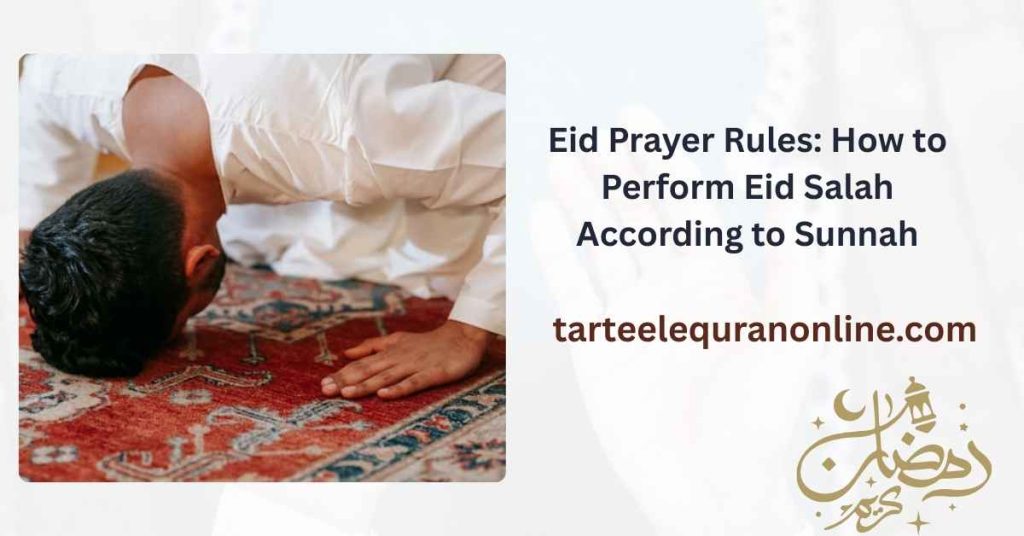
Eid Prayer Rules
The blessed days of Eid al-Fitr and Eid al-Adha are marked by a unique act of worship that distinguishes them from all other days of the year: the Eid prayer (Ṣalāt al-‘Eid). For over twenty years, I have taught students that understanding the Eid prayer rules is essential, not merely to perform the ritual correctly, but to preserve the Sunnah in its precise prophetic form.
Eid prayer is not an ordinary congregational Salah. It carries distinct rulings, additional Takbeerat, specific timing, and particular Sunnah practices that frame the joy and gratitude of the occasion. Observing these rules carefully ensures that our celebration remains anchored in revelation rather than cultural improvisation.
The Legal Status of Eid Prayer
Scholars differ regarding the ruling of Eid prayer. The Hanafi school considers it wajib (obligatory) upon adult Muslim males who are required to attend Jumu‘ah. The majority of scholars — including the Shafi‘i and Maliki schools — regard it as Sunnah Mu’akkadah (highly emphasized Sunnah), while some Hanbali scholars consider it fard kifayah (a communal obligation).
The strength of its obligation is supported by the practice of the Prophet ﷺ, who never abandoned it. ‘Abdullah ibn ‘Umar (رضي الله عنهما) reported that the Messenger of Allah ﷺ would go out for the Eid prayer consistently.
In addition, Umm ‘Atiyyah (رضي الله عنها) said:
“We were commanded to bring out the young women, menstruating women, and those in seclusion on the two Eids, so that they may witness the goodness and the supplication of the Muslims.”
— Sahih al-Bukhari 971; Sahih Muslim 890
This Hadith indicates the emphasized nature of Eid prayer, as even those not praying were encouraged to attend the gathering.
Time of the Eid Prayer
One of the most important Eid prayer rules concerns its timing. The prayer begins after sunrise, once the sun has risen approximately a spear’s length above the horizon (about 15–20 minutes after sunrise), and it continues until before the zenith (Zawal).
Unlike the five daily prayers, there is no Adhan or Iqamah for Eid prayer. Jabir ibn Samurah (رضي الله عنه) said:
“I prayed Eid prayer with the Messenger of Allah ﷺ more than once or twice without Adhan or Iqamah.”
— Sahih Muslim 887
This distinguishes Eid prayer from the regular congregational prayers.
Number of Rak‘ahs and Structure
Eid prayer consists of two Rak‘ahs, prayed in congregation.
In the first Rak‘ah, after the opening Takbeer (Takbeer al-Ihram), additional Takbeerat are recited before Surah al-Fatiha. In the second Rak‘ah, additional Takbeerat are recited before Ruku‘.
‘Aishah (رضي الله عنها) reported:
“The Messenger of Allah ﷺ used to say Takbeer in the Eid prayer — seven Takbeerat in the first Rak‘ah and five in the second.”
— Sunan Abu Dawud 1150; Jami at-Tirmidhi 536 (authentic)
According to the Hanafi school, there are three additional Takbeerat in each Rak‘ah. This difference is based on variant narrations, and both practices are established in fiqh. Over the years, I have emphasized to students that such juristic differences reflect richness, not contradiction.
Recitation in Eid Prayer
It is Sunnah for the Imam to recite aloud. The Prophet ﷺ commonly recited:
- Surah Al-A‘la (87) in the first Rak‘ah
- Surah Al-Ghashiyah (88) in the second
As narrated in Sahih Muslim 878.
In some narrations, he recited Surah Qaf (50) and Surah Al-Qamar (54). These selections remind believers of resurrection, accountability, and divine power — themes appropriate for days of gratitude and sacrifice.
The Khutbah After the Prayer
Another essential Eid prayer rule is that the Khutbah comes after the prayer, unlike Jumu‘ah where it precedes the prayer.
Ibn ‘Abbas (رضي الله عنهما) said:
“I witnessed Eid with the Messenger of Allah ﷺ, Abu Bakr, ‘Umar, and ‘Uthman. They all prayed before delivering the sermon.”
— Sahih al-Bukhari 962; Sahih Muslim 884
Listening to the Khutbah is recommended but not obligatory according to the majority of scholars.
Sunnah Acts Before Eid Prayer
For Eid al-Fitr, it is Sunnah to eat an odd number of dates before leaving for prayer.
Anas ibn Malik (رضي الله عنه) reported:
“The Messenger of Allah ﷺ would not go out on Eid al-Fitr until he had eaten some dates.”
— Sahih al-Bukhari 953
For Eid al-Adha, it is recommended to delay eating until after returning from prayer and then eat from the Qurbani meat.
Takbeer on the Way to Eid Prayer
It is Sunnah to recite Takbeer while proceeding to the place of prayer, particularly during Eid al-Adha and the nights of Eid al-Fitr.
Allah says:
وَلِتُكْمِلُوا الْعِدَّةَ وَلِتُكَبِّرُوا اللَّهَ عَلَىٰ مَا هَدَاكُمْ
“And so that you may complete the number and glorify Allah for having guided you.”
(Surah Al-Baqarah 2:185)
The companions would recite Takbeer audibly, creating an atmosphere of remembrance and unity.
Performing Eid Prayer at the Musalla
The Prophet ﷺ would typically perform Eid prayer in an open area (musalla) rather than inside the mosque, except when weather conditions prevented it.
This practice symbolizes communal unity and public manifestation of worship.
Is Eid Prayer Valid at Home?
Under normal circumstances, Eid prayer is meant to be performed in congregation. However, scholars allowed it at home in exceptional situations, such as widespread illness or inability to attend the congregation. During recent global crises, this issue was revisited extensively by contemporary scholars.
In ordinary conditions, the Sunnah remains to attend the congregational prayer.
Women and Eid Prayer
Women are strongly encouraged to attend Eid prayer, even if they are not praying due to menstruation, as established in Sahih al-Bukhari 971. This reflects Islam’s inclusive approach to communal worship.
Reflection from Years of Teaching
Over two decades of teaching at Tarteel E Quran Online Academy and in traditional settings, I have observed that many Muslims celebrate Eid joyfully but remain unaware of the precise Eid prayer rules. When knowledge is restored, the prayer becomes more than ceremony — it becomes a conscious revival of Sunnah.
Understanding the Takbeerat, the timing, the Sunnah recitations, and the prophetic method transforms the experience of Eid morning. Instead of rushed attendance, the believer walks to the prayer with awareness, Takbeer on the tongue, and gratitude in the heart.
The Spiritual Meaning Behind the Rules
Eid prayer marks completion — completion of fasting in Ramadan or completion of the rites of Hajj. It is an outward expression of inward gratitude. The additional Takbeerat symbolize magnification of Allah above worldly concerns. The congregation represents unity of the Ummah. The Khutbah provides guidance at a moment of communal joy.
The rules governing Eid prayer are not restrictive details; they are protective boundaries ensuring that celebration remains worship. When performed as taught by the Messenger of Allah ﷺ, the Eid prayer stands as one of Islam’s most beautiful collective acts of devotion.
FAQ Answers
Q1: What are the rules of Eid prayer?
Eid prayer is two rak‘ahs with extra takbeers, offered in congregation after sunrise.
The prayer of Eid al-Fitr and Eid al-Adha includes additional takbeers and a khutbah (sermon) afterward.
It must be prayed after the sun has risen (about 15–20 minutes after sunrise) and before Dhuhr time. There is no adhan or iqamah for Eid prayer.
Q2: How to pray Eid prayer Hanafi?
In the Hanafi method, Eid prayer is two rak‘ahs with 6 extra takbeers.
Step-by-step (Hanafi):
-
Make intention for Eid prayer.
-
Say Takbeer al-Tahrimah (Allahu Akbar) and fold hands.
-
Recite Sana.
-
Say 3 extra takbeers (raising hands each time).
-
Recite Surah Al-Fatihah and another surah.
-
Complete the first rak‘ah normally.
-
In the second rak‘ah, recite Al-Fatihah and another surah.
-
Say 3 extra takbeers before going into ruku.
-
Complete the prayer normally.
This makes a total of 6 extra takbeers according to the Hanafi school.
Q3: How to pray Eid Fitr prayer step by step?
Eid al-Fitr prayer consists of two rak‘ahs with extra takbeers and a khutbah afterward.
The method varies slightly by madhhab, but it always includes extra takbeers in both rak‘ahs.
After the prayer, listen to the khutbah. Unlike Jumu’ah, the khutbah comes after the prayer.
Q4: How to pray missed Eid prayer?
If you miss Eid prayer in congregation, you cannot make it up individually in the Hanafi view.
Other schools allow praying it at home without khutbah.
It’s best to attend in congregation because Eid prayer is meant to be a communal act of worship.
Q5: Is it haram to miss Eid prayer?
Missing Eid prayer without a valid excuse is sinful according to many scholars.
In the Hanafi school, Eid prayer is wajib (necessary). Deliberately missing it without reason is blameworthy.
However, illness or genuine hardship is excused.
Q6: What is the punishment for missing prayer in Islam?
Deliberately missing obligatory Salah is a major sin.
The Qur’an strongly warns against neglecting prayer.
Scholars say continuous abandonment of prayer can lead to severe consequences in the Hereafter. Repentance and making up missed prayers (Qada) are essential.
Q7: What are the 3 biggest sins in Islam?
The three gravest sins mentioned in hadith are:
-
Shirk (associating partners with Allah)
-
Murder
-
Disobedience to parents
Shirk is considered the greatest sin in Islam.
Q8: Does Allah forgive missed Salah?
Yes, Allah forgives if a person sincerely repents.
Allah is Most Merciful and accepts repentance for missed Salah when a person regrets it, seeks forgiveness, and begins praying consistently.
Making up missed prayers (Qada) strengthens that repentance.
Q9: Is missing Salah worse than zina?
Both are major sins.
Some scholars consider abandoning Salah completely worse because prayer is the pillar of Islam.
However, zina (fornication/adultery) is also a grave major sin with severe consequences.
Q10: What sin will Allah never forgive?
Shirk (associating partners with Allah) is not forgiven if a person dies without repentance.
If someone repents sincerely before death, even shirk can be forgiven.
This is clearly mentioned in the Qur’an.
Q11: How do I repay missed Salah?
Missed prayers must be made up as Qada prayers.
Pray the missed obligatory Salah in addition to your daily prayers until they are completed.
Scholars advise starting immediately and maintaining consistency along with sincere repentance.